Mini Split Installation in Blanding, UT
A new system here will heat from October through May and cool from June through August every year. Tell us about the house, and a licensed contractor who covers San Juan County will get in touch.
Tell us about the job
It takes about a minute.
What Blanding winters and summers ask of a mini-split
Blanding needs heat or cooling 11 months of the year. Winter nights average 23°F from December through February, and a mini-split has to hold its own on those nights, not just on the mild ones. Summer afternoons average 89°F, so the same unit is doing real work in both directions.
Any new mini-split you install has to meet the federal minimum for a split-system heat pump, 14.3 SEER2 for cooling and 7.5 HSPF2 for heating, if it was built on or after January 1, 2023. With a heating season that runs October through May, the heating side of that rating matters as much as the cooling side here.
- 8 months
- October through May, your system heats
- 3 months
- June through August, it cools
- 23°F
- the average winter night it heats against
- 89°F
- the average summer afternoon it cools against
NOAA nClimDiv, 1991–2020 normals
Utah requires HVAC contractors to hold a state license.
Utah licenses HVAC contractors through the Division of Professional Licensing. The license covers the contractor, not each individual job, so it tells you the person or company was checked, not that this particular installation was reviewed by the state. Utah also sets a line at $7,000. Work under that amount does not need a licensed contractor.
A mini-split installation can fall on either side of that line depending on the system and the work involved. If the job is over $7,000, the license is what stands behind whoever does it. If it falls under that amount, the license requirement does not apply. Most cities and counties in Utah still require a permit for this kind of installation and an inspection once the work is done, which checks that the unit is installed and connected the way it should be.
Sources: Utah State Legislature · Utah Department of Commerce
- Is a mini split worth it?
- For most homes, yes, especially if a room runs hot or cold with no ductwork to fix it. A mini split heats and cools that one space without tearing into walls for ducts. Blanding winters drop to 23°F on average and summers reach 89°F, and a mini split rated for cold climates can handle both if it's sized right for the room. A contractor can tell you whether it fits your situation better than central air or a furnace add-on.
- How many rooms can a mini split cover?
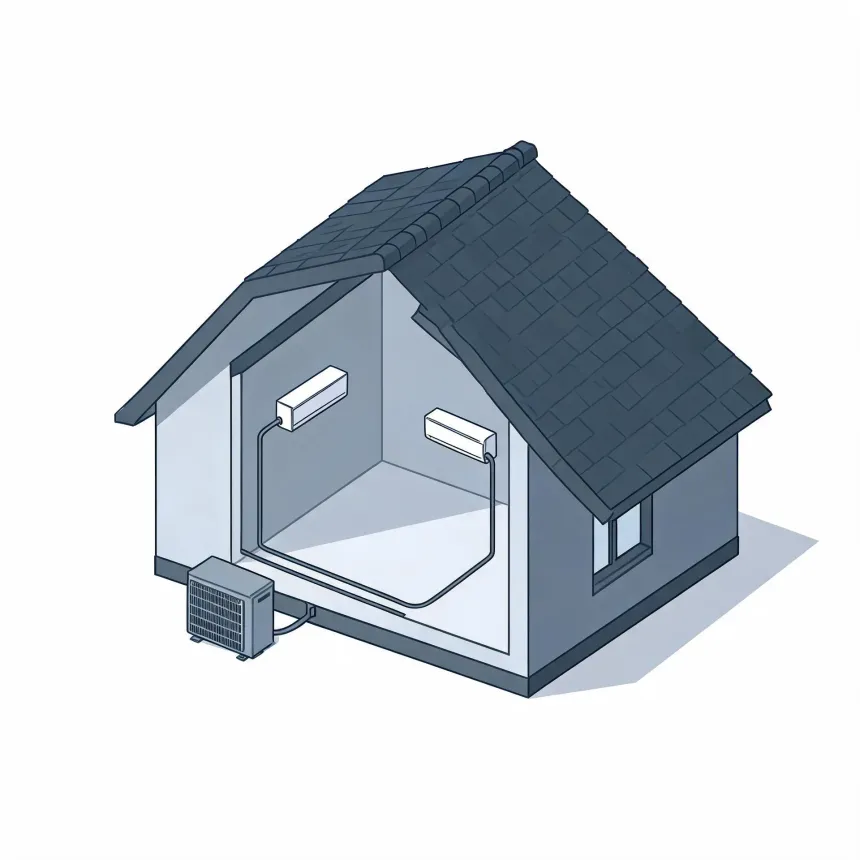
- A single-zone mini split covers one room or open area. If you need more than that, a multi-zone system connects one outdoor unit to several indoor heads, each one running its own room. Most multi-zone setups handle two to eight rooms, depending on the outdoor unit and how much heating or cooling each room needs. A contractor sizes the system room by room rather than guessing at a number that fits every house.
- Can a mini split heat a whole house?
- It can, if you install enough zones to cover every room and size each one for that room's heat loss. Blanding needs heat from October through May, eight months a year, so the outdoor unit has to keep working through nights averaging 23°F without losing capacity. Cold-climate mini splits are built for that, but the system still has to be sized for the whole house, not just the biggest room. A contractor can walk through the house and lay out how many zones it would take.