Mini Split Installation in Layton, UT
A new system here will heat from October through May and cool from June through August every year. Tell us about the house, and a licensed contractor who covers Davis County will get in touch.
Tell us about the job
It takes about a minute.
What a mini-split in Layton has to handle
Layton needs heat or cooling 11 months of the year. Winter nights average 22°F from December through February, and a mini-split's heat pump side has to keep pulling warmth out of air that cold for eight months straight, October through May. Summer only asks three months of it, with afternoons averaging 84°F, but the same unit has to switch modes and handle both.
Most homes here heat with gas, so a new mini-split is often going in alongside a furnace rather than replacing the only source of heat, or it's covering a room the furnace doesn't reach well. Either way, any unit made on or after January 1, 2023 has to meet 14.3 SEER2 for cooling and 7.5 HSPF2 for heating. That's the floor. In a place where winter runs long and cold, the heating side of that rating matters as much as the cooling side.
- 8 months
- October through May, your system heats
- 3 months
- June through August, it cools
- 22°F
- the average winter night it heats against
- 84°F
- the average summer afternoon it cools against
NOAA nClimDiv, 1991–2020 normals
Utah requires HVAC contractors to hold a state license.
The license is issued to the contractor, not to the job. It covers who they are, not what they charge for one installation. Utah does carve out an exception. Work under $7,000 does not need a licensed contractor at all. A mini-split installation can land on either side of that line depending on the system and the scope of the job.
When the job calls for a licensed contractor, that license is what stands behind the work, checked and recorded by the Division of Professional Licensing. Most cities and counties in Utah also require a permit for this kind of installation, with an inspection once the work is finished. That inspection is a local check on the work itself, separate from the state license.
Sources: Utah State Legislature · Utah Department of Commerce
- Is a mini split worth it?
- For most homes, yes, especially if a room or two never gets warm or cool enough with the main system. A mini split gives that space its own heat pump, so it can run without touching the rest of the house. Here, winter lows average 22°F and the cold season runs October through May, so the unit needs to handle real heating load, not just take the edge off. New units sold now have to meet 7.5 HSPF2 for heating and 14.3 SEER2 for cooling, so efficiency is set by federal standard, not by brand claims.
- How many rooms can a mini split cover?
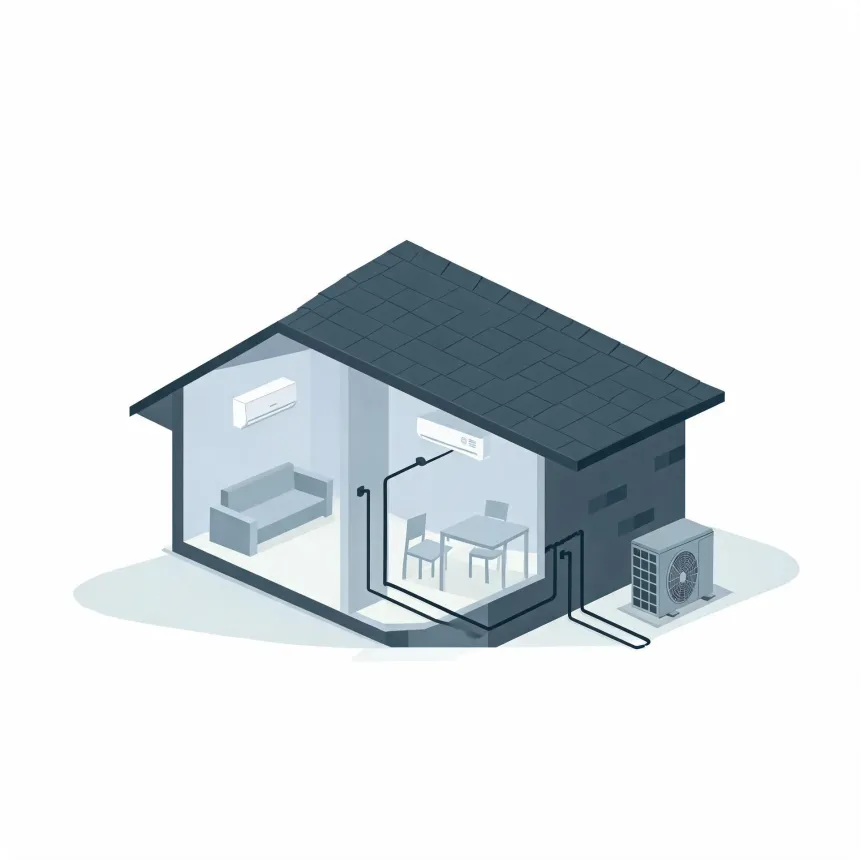
- One outdoor unit can run up to eight indoor heads, so it can cover several rooms at once, each with its own thermostat. A single-zone system is built for one space. A multi-zone system splits its capacity across every head connected to it, so a contractor sizes the whole setup to the rooms it needs to reach, not room by room after the fact.
- Can a mini split heat a whole house?
- It can, if it is sized and placed for that from the start. A multi-zone system with enough heads reaching every room can replace a central furnace, and heat pump technology now works down to very low outdoor temperatures. With winter nights here averaging 22°F, the house needs a system sized for that cold, not just for milder days, so a contractor should size it against the coldest nights the house sees, not an average.