Mini Split Installation in Ephraim, UT
Tell us about the house, and a licensed contractor who covers Sanpete County will get in touch.
Tell us about the job
It takes about a minute.
Ephraim asks a mini-split to heat, not cool
Nights here average 16°F in December through January and February, and the heating season runs September through June, ten months of the year. That is what a mini-split in Ephraim is really for. Cooling barely enters into it, since summer afternoons only average 78°F.
A mini-split heat pump has to be sized and installed for that long, cold heating stretch, not for a handful of hot afternoons. Any unit installed new has to meet the federal minimum of 7.5 HSPF2 for heating and 14.3 SEER2 for cooling, since a ductless heat pump falls under the same split-system standard as any other. Most homes here still heat with gas, so a new mini-split is often going in alongside a furnace rather than replacing the only heat source in the house.
- 10 months
- September through June, your system heats
- 16°F
- the average winter night it heats against
- 78°F
- the average summer afternoon it cools against
Utah requires HVAC contractors to hold a state license.
The Division of Professional Licensing tests and licenses HVAC contractors in Utah, and that license belongs to the contractor, not to any one job. Utah also sets a line at $7,000. Work under that amount does not require a licensed contractor, though a mini-split installation often runs past that once the equipment and labor are added up.
For a job over that line, the license is what stands behind the person doing the work here, the state tested them before they could hold it. Most cities and counties in Utah also require a permit for this kind of installation, with an inspection once the work is finished. That inspection happens through the local building office rather than the state licensing board, and it is what checks that the work was done right.
Sources: Utah State Legislature · Utah Department of Commerce
- Is a mini split worth it?
- For most homes here, yes, because a mini split works as both a heater and an air conditioner in one system, and this is a place that needs heat ten months of the year. Winter nights average 16°F from December through February, so the heat pump is doing most of its work in cold weather, not mild weather. Look for a unit built for cold climates, since it has to keep producing heat at those low temperatures. A contractor can size the system to your house and tell you what to expect.
- How many rooms can a mini split cover?
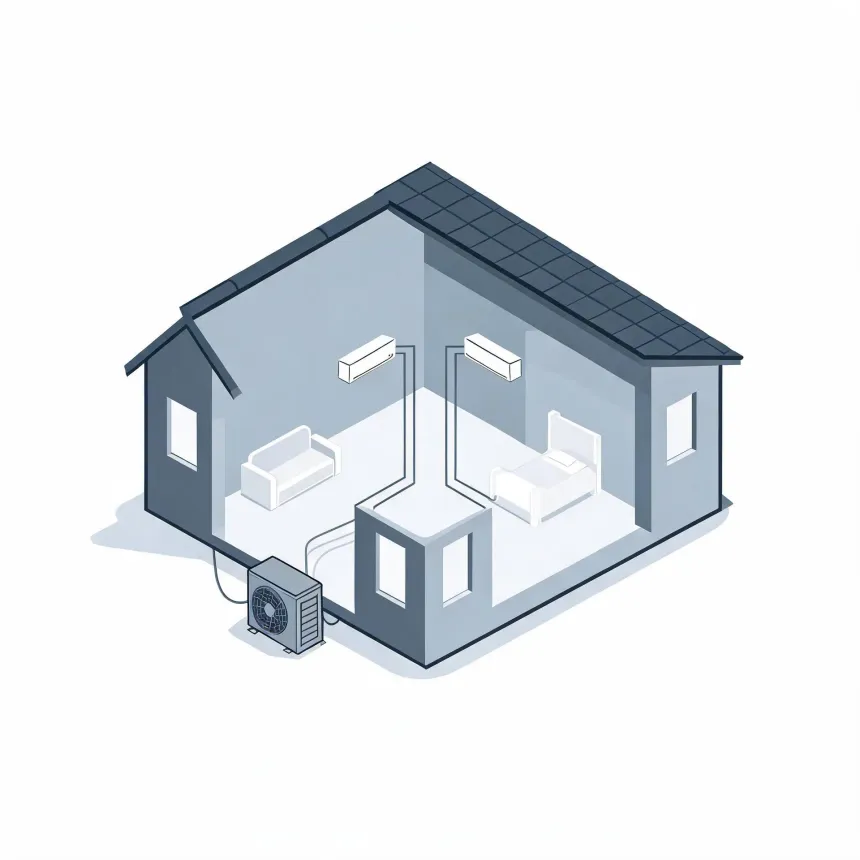
- A single outdoor unit can run one indoor head or several, depending on the system. A single-zone system covers one room or an open area well. A multi-zone system splits output across several indoor heads, each with its own thermostat, so bedrooms and living areas can run at different temperatures at the same time. How many zones your house needs comes down to the layout, so a contractor will walk through it room by room.
- Can a mini split heat a whole house?
- It can, if it's sized and placed to cover every room, but that takes planning. A single indoor head heats the room it's in and whatever space is open to it. Closed-off bedrooms and rooms down a hall usually need their own head to stay warm. With winter lows here averaging 16°F, whole-house coverage also depends on choosing a cold-climate heat pump that keeps its output up at those temperatures. A contractor can lay out how many zones your house needs to heat it end to end.