





Side profile of a bearded man wearing a faded dark blue baseball cap and a matching dark T-shirt against a plain light gray background.

Mold in air ducts in Provo, UT

Duct and vent cleaningDucts or ventsUtah County, UT
Step 1 of 2

What ZIP code is the job in?

Mold in air ducts usually means moisture got in somewhere, from a condensate line that drains near the ductwork, a duct running through a damp crawl space, or humidity that got trapped in the system and never dried out. In Utah County the air itself runs dry most of the year, so when you see mold around a vent or smell something musty when the air kicks on, it almost always traces back to a specific wet spot rather than general humidity. That smell, or dark spots around the vent covers, means spores are moving through the air every time the system runs, into bedrooms and living rooms alike. It will not go away by changing the filter or running the fan longer. The duct run has to be found, cleaned, and the moisture source fixed, or it comes back within months. Mold in ducts is also a health question for anyone with allergies or asthma in the house, not just a smell to cover up.

Why does mold show up in ducts if the air here is so dry?

  • Half the homes here were built by 2001

    If your house went up by 2001, the ducts have had decades to pick up a leak, a damp crawl space, or a return that was never sealed right.

  • Heat runs September through May

    Heat runs September through May here, nine months of warm air moving through the ducts and past any damp spot, which is what lets mold take hold.

  • Cooling runs July through August

    Cooling only runs July and August, so the same ducts sit shut up most of the year. Moisture that gets in has little airflow to dry it out.

ACS 2020-2024 · NOAA nClimDiv 1991-2020

Mold needs a water source, and that source is usually mechanical, not the weather. A condensate line that backs up, a duct seam in a crawl space, a humidifier on the furnace that overshoots. Find the water and the mold stops coming back.

Dry air outside doesn't reach what's sealed inside a duct run. A wet spot behind the drywall or under the house stays wet until something is fixed, no matter what the forecast says in Provo.

A smiling bearded man in a navy long-sleeve shirt sits on a gray sofa in a living room, with a bowl of popcorn in the foreground and shelves and a window behind him.
A smiling bearded man in a dark sweatshirt sits on a sofa in a living room with a bowl of popcorn and a mug in the foreground, a potted plant and large window behind him.
A bearded man in a dark green shirt over a white tee sits smiling on a gray sofa in a living room, with a patterned cushion and a bowl of popcorn nearby and a kitchen with pendant lights blurred in the background.
A smiling man in a dark long-sleeved henley shirt reclines on an olive-green sofa in a living room, with a wooden bowl of popcorn in the foreground and shelving and a large potted plant behind him.

What a cleaning actually removes

A duct cleaning clears the dust, debris and mold growth sitting on the inside surfaces of the supply and return runs, plus the coil and blower compartment if the contractor opens them up. It does not fix a condensate line that keeps backing up or a damp crawl space feeding moisture into the system. Those are repairs, separate from cleaning. If the water source is still there after the ducts are cleaned, mold comes back in the same spots, usually within a season. A contractor who finds standing water, a disconnected drain line, or a duct seam that is wet to the touch will flag it, because cleaning over an active leak just buys a few months.

Why the return side matters most

Mold tends to show up heaviest on the return side of the system, where air comes back into the furnace or air handler rather than where it leaves. Return ducts pull air from more places in the house, including crawl spaces and closets where humidity sits longer, and they carry whatever moisture is in that air straight to the coil. A return that was never sealed tight at the joints draws in damp air every time the blower runs, nine months a year here. Checking the return boots and the seams near the furnace is where a contractor usually finds the source, not the supply runs feeding the rooms.

An unfinished basement with bare concrete walls and floor, showing exposed wooden floor joists, pipes, wiring, and metal HVAC ducts with a vent grille overhead.
Before you get your ductwork cleaning
Unfinished basement with galvanized sheet-metal rectangular and round ductwork running along a wood-joist ceiling, two steel support columns, a small window, and a furnace unit against the far right wall.
After you get your ductwork cleaning
Unfinished basement with bare concrete walls and floor, showing exposed wood floor joists overhead with sheet-metal rectangular ductwork, insulated flexible ducts, and pipes.

Ducts doing their job

This is what a duct system looks like when it's dry inside. Air moves through the trunk lines and flex runs, drops off at the vents, and nothing lingers long enough to grow anything. No standing water near the joists, no damp insulation around the pipes.


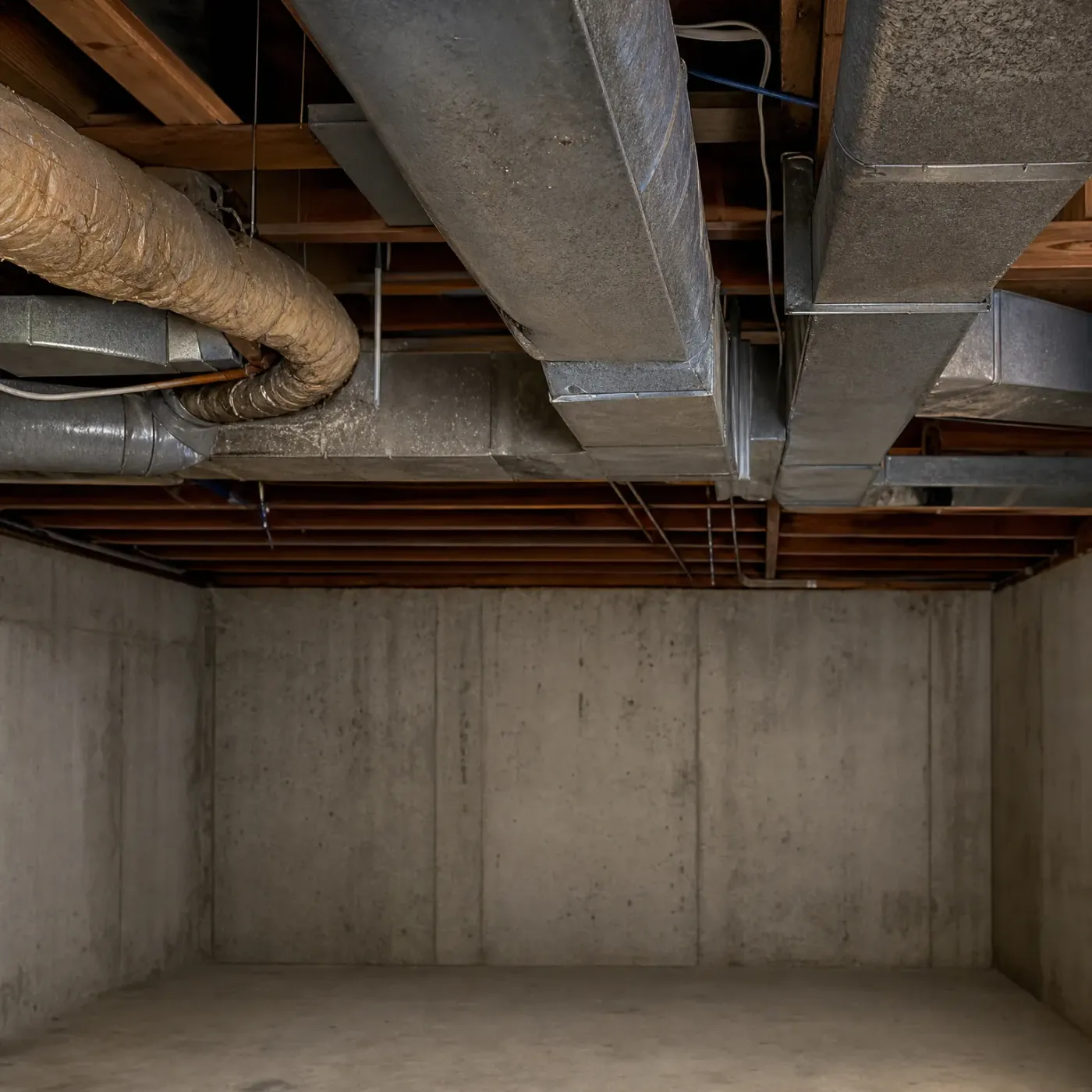
Basement ceiling with galvanized sheet metal rectangular ducts and round pipes running between wooden joists above a bare concrete wall and floor.

Ducts holding moisture

Same kind of basement, same metal ductwork, but something upstream is feeding water into the system. A condensate line, a seam that sweats, a return pulling in damp air. Given a water source and a dark duct interior, mold has what it needs to spread along the metal.

A woman in a cream knit sweater reclines on a gray sofa with her eyes closed and a slight smile, covered by a fleece blanket with a closed book on her lap, a lit table lamp and potted plants behind her.
A smiling man with curly graying hair and a dark knit sweater sits at a candlelit dinner table with a glass of red wine, a water glass and a bowl of salad in the foreground, in a dimly lit room with a lamp, framed picture and window behind him.

Nine months a year through the ducts

Furnace air runs September through May. Anything growing in the ducts rides that air into every room of the house, not just the one near the leak.

Get my match

One coil, one blower, one set of vents

Mold doesn't stay where it started. It sits on the coil, the blower compartment, and every run connected to it, so one damp spot becomes a whole-system problem.

Get my match
A man in a dark jacket and khaki pants walks through an open gate in a stone wall toward a woman standing in the open front doorway of a single-story white house with a dark shingled roof and river-rock accents.

How mold actually spreads through a duct run

A duct system is one loop of air, not separate rooms. The blower pulls return air across the coil, pushes it through the trunk line, and splits it off into the flex runs that feed each vent. If mold is growing on a cold coil or in a damp spot of ductwork, spores ride that same air to every room the system feeds. There's no isolating it to one register or one hallway. The whole supply side carries whatever the air picks up at the start.

That's why a contractor who actually opens the system matters more than one who sprays a vent and leaves. The blower compartment, the coil, the plenum, and the full run of ducts all need to be seen before anyone can say where the moisture is coming from and whether the cleaning reached it. A contractor matched to your house and your system can tell you what they found in yours, not what's typical.

A dark ceramic vase holding a leafy green branch sits on a round wooden table, with a blurred cushioned wooden armchair, woven basket, window and shelving with pottery in the background.
A dimly lit interior wall with a ceiling air vent above a wooden sideboard holding a potted plant, a shallow bowl, and a table lamp beside a curtained window.

It is late April, and the afternoon light comes low through the living room window in Provo. The furnace hasn't run in days now that the weather's turned, but the vent grille on the ceiling still shows it: a gray line of dust along every slat, thicker in the corners. On the side table below, a fine film has settled over a stack of mail and the lamp's base. You run a finger along the grille and it comes away dark. The room looks clean otherwise, the kind of clean you keep up with, and that's what makes you stop and look twice at the vent.

Get your ductwork to the right pro

One request and the duct cleaning stops waiting on you.

Sending the form costs nothing.

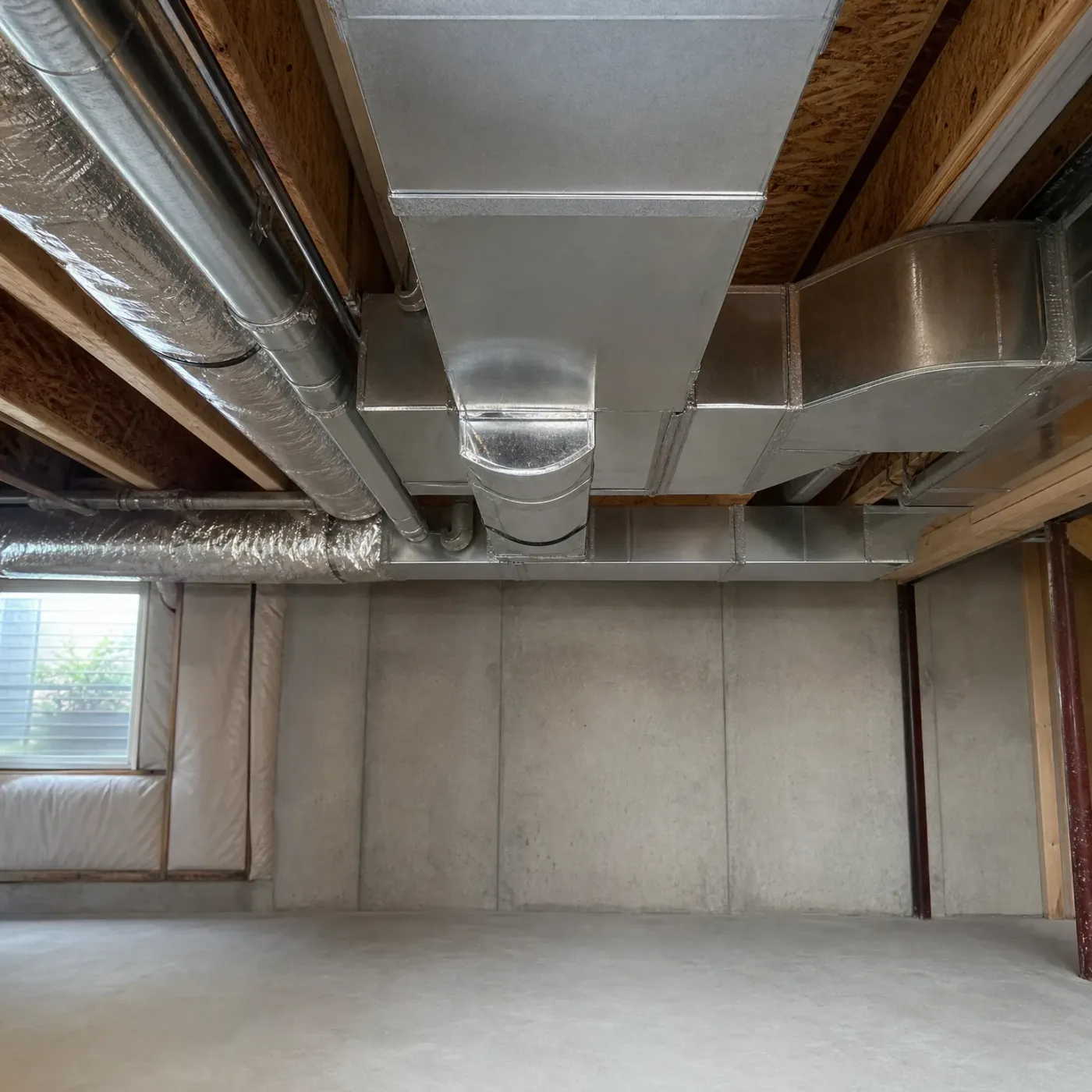
Unfinished basement with galvanized sheet-metal ductwork and pipes beneath wood joists, a gray furnace unit at left, insulated plastic-covered walls over a concrete foundation, and a bare concrete floor.

Dry, sealed, working right

This is a duct system with no water problem. The metal trunk lines run tight along the joists, the vapor barrier on the foundation walls keeps ground moisture out of the basement air, and the furnace sits ready to move air through ducts that stay dry year round.

Empty concrete-walled basement room with galvanized rectangular and round HVAC ducts and pipes running along the exposed wood-joist ceiling.

Open to moisture

Here the ducts run bare through an unfinished basement with nothing between them and the concrete. No vapor barrier on the walls, no lining to stop moisture from the block from reaching the metal. Any dampness in this room has a direct path to the inside of every duct run.

Clean the Ducts or Fix the Cause

Clean the ducts

  • Removes the dust, debris and mold growth sitting on the inside of the supply and return runs right now.
  • Takes the coil and blower compartment back to clean if the contractor opens them up during the job.
  • Stops that gray line of growth from riding the furnace air into every room for the rest of this heating season.
  • Gives you a system you can see is clean, which matters if anyone in the house reacts to what's been blowing through it.
  • Does nothing about the condensate line, crawl space or humidifier setting that let the moisture in to begin with.
  • Leaves the water source in place, so a duct that grew mold once has the same conditions to grow it again.

Find the water source

  • Fixes the actual reason mold had something to grow on, since dry duct surfaces don't support it no matter how much dust collects.
  • Means checking the condensate line, the crawl space the ducts run through, and the humidifier settings if the furnace has one attached.
  • Stops mold from coming back after a cleaning instead of giving it a few months before it's visible again.
  • Takes more than one visit sometimes, since the source isn't always the first thing checked.
  • Leaves the existing growth and debris inside the ducts untouched until a cleaning is done separately.
  • Matters most if a system has shown mold before, since a repeat problem means the water was never addressed.
  1. Moisture settles in a duct seam, a crawl space run, or the coil

  2. Mold spores already in the air find that wet surface and take hold

  3. The colony spreads across duct walls as the blower moves air past it

  4. Spores and musty air ride the supply runs into every room

Empty unfinished basement with bare concrete walls and floor, showing galvanized sheet metal ductwork, insulated flexible duct, and pipes running along the wood-framed ceiling, with a small window at left.
Metal trunk lines and round pipes run clean across the joists, nothing dripping, nothing dark at the seams.
Empty basement room with bare concrete walls and floor, with exposed wooden joists, sheet-metal HVAC ducts, an insulated flexible duct, and pipes running across the ceiling.
Insulation batting is dry around the egress window, concrete floor bare and unstained where ducts cross overhead.

Power here costs 12.64 cents per kilowatt-hour

Cleaning a duct system doesn't touch your power bill, but the blower pushing that air does, and at 12.64 cents a kilowatt-hour it isn't cheap to run a blower working harder than it should. A duct full of dust and mold buildup makes the blower strain to move the same air through every vent in the house.

EIA-861 2025

Where this leaves you

  • Mold in a duct almost always traces back to a water source, not to how dry the air outside gets.
  • A condensate line, a damp crawl space run, or a humidifier set too high are the usual places moisture got in.
  • Furnace air runs September through May here, so anything growing in the ducts rides into every room for nine months.
  • Cleaning clears the dust and growth already sitting on the duct walls, coil and blower compartment.
  • Finding and sealing the water source is a separate job from cleaning, and the one that keeps mold from coming back.
  • Once a contractor is on the job, sorting out which problem you have stops being something you have to figure out alone.

Mold in a duct system has a cause, and it's almost never the dry air outside your door. Somewhere there's a water source: a condensate line that drains wrong, a duct seam in a damp crawl space, a humidifier on the furnace set higher than the house needs. Find that source and the mold has nothing left to feed on. Leave it alone and cleaning the ducts buys you time, not a fix, because furnace air runs September through May here and whatever is growing in that system rides along with it into every room, nine months at a stretch. A cleaning takes care of what's already there. It clears the dust and growth sitting on the duct walls, the coil, the blower compartment, and gets the air moving clean again. But the water problem behind it is a separate job, and it's the one that decides whether this comes back next year or stays gone. You don't have to sort out which of the two you're dealing with on your own. A contractor who looks at the system can tell you whether it's a condensate line, a crawl space run, or a humidifier overshooting, and whether cleaning alone covers it or something upstream needs fixing first. Once that call is made, the rest of it, figuring out what's wrong and who handles it, stops being your problem to carry. You send the form, and from there it's someone else's job to find out what your ducts are telling you.

A lit ceramic table lamp with a linen shade sits on a round wooden side table with a small vase of greenery and a dark shallow bowl, beside a beige upholstered sofa with a cushion and knit throw, below a framed artwork on a pale wall.
Corner of a beige linen sofa with a large woven cushion and a fringed knit throw, beside a potted leafy tree in a woven basket against a neutral wall.
Sunlit interior corner with a wood-framed armchair with beige cushions and a striped pillow, a leafy plant in a tall ceramic pot, a window with wood sill showing green foliage outside, and dark wood flooring.
A lit black path light beside a stone walkway leading to a dark front door of a white clapboard house, with shrubs and flowering plants in the bed at dusk.
A covered porch at dusk with a wooden front door, a lit lantern wall sconce on gray horizontal siding, a black rocking chair with a cream throw, a potted white flowering plant, a coir doormat, and a window showing a lit interior lamp.

Find a duct system cleaning pro in Utah County

Once you send the form, finding a pro is off your list.

Hand it over

You're not committing to anything by asking.